Short answer
Human waste and bodily fluids carry bacteria, viruses, and parasites that can survive for days to months on household surfaces. Effective cleanup follows chemistry and biology: remove the organic material, choose a disinfectant whose label covers the likely organisms, keep it wet for the full contact time, and remove porous materials that fluid has soaked into. Gases from sewage and old urine add a separate breathing hazard.
What is actually in human waste?
Stool is not just digested food. A large share of its mass is bacteria, living and dead, along with shed intestinal cells, water, and anything the body is trying to clear. When someone is sick, it can also carry viruses such as norovirus or rotavirus, parasites such as Giardia, and bacteria such as Salmonella, Shigella, and toxin-producing E. coli.
The concentration is what surprises most people. Even a small smear on a toilet seat or a child's changing table can hold a meaningful dose if it reaches someone's hands and then their mouth.
Urine, vomit, and blood
Urine from a healthy person is less of an infection concern, but it is rarely the only problem. Long-term urine contamination feeds bacteria that break down urea into ammonia, and it often travels with fecal matter in situations involving illness, incontinence, pets, or a failing sewer line. Vomit can carry the same viruses as stool, particularly during a norovirus illness.
Blood and other fluids from a person who is injured or ill raise additional concerns, including bloodborne viruses. Treat any fluid you did not expect to find as potentially infectious until someone qualified has assessed it.
How long can germs from stool and vomit survive on surfaces?
Longer than most people expect, and the answer depends heavily on the organism. A systematic review by Kramer, Schwebke, and Kampf, published in BMC Infectious Diseases in 2006, found norovirus persists on dry inanimate surfaces for 8 hours to 7 days, and rotavirus for 6 to 60 days.
Bacterial spores are an even tougher case. C. difficile, which is spread through stool, forms spores that resist drying, heat, and many common cleaners. That is why a spill that happened last week is not automatically safe just because it has dried out.
Temperature, humidity, and the surface itself all shift these timelines. Cool, damp, shaded areas such as basements and behind toilets tend to favor survival. Sunlight, heat, and dry air tend to shorten it, but none of them can be relied on as a disinfection method.
Clean first, then disinfect
Disinfectants are chemicals that react with the outer structures of microbes. Organic material, such as stool, vomit, blood, or the film left by old urine, reacts with those same chemicals and uses them up. It also forms a physical shield that the product may not penetrate.
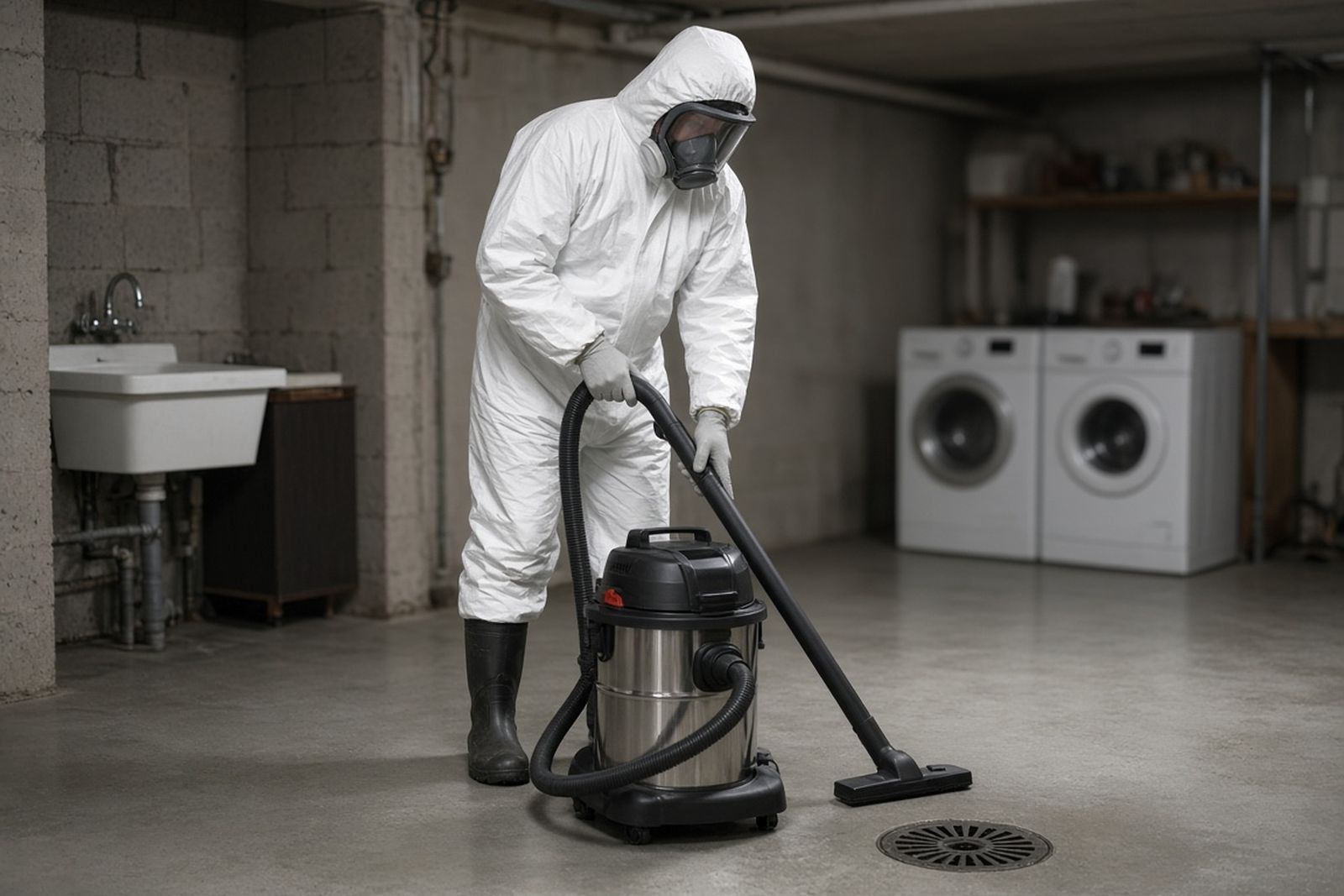
So the order matters. First, bulk material is removed with disposable tools and absorbent materials. Then the surface is washed with detergent and water to lift the remaining film. Only then is the disinfectant applied, to a surface it can actually reach.
Skipping the washing step is one of the most common reasons a household cleanup fails. The area smells like bleach and looks clean, but organisms remain protected in a thin layer of residue, especially in grout lines, textured flooring, and the gap where a toilet meets the floor.
Contact time, and why labels differ so much
Contact time, sometimes called dwell time, is the period a surface must stay visibly wet with the disinfectant to achieve the kill claim printed on the label. It is tested against specific organisms, so the same product might list one minute for one bacterium and ten minutes for a hardier virus.
For waste-related work, the organisms that set the bar are usually norovirus and C. difficile spores. The EPA maintains lists of registered products tested against each. Those lists show wide variation, which is why a professional will check the label against the likely organism rather than reaching for whatever is on the truck.
If a surface dries before the time is up, you reapply. Wiping it off early, or spraying and immediately drying it with a towel, means the product may not have finished working.
Porous materials: carpet, drywall, and mattresses
Porous materials absorb liquid into their structure. Carpet fibers wick fluid down into the pad and sometimes into the subfloor. Drywall paper and gypsum pull moisture upward. Mattresses and upholstered furniture hold fluid in foam and batting that no surface treatment can reach.
Once waste has soaked in, disinfectant applied to the surface cannot contact the organisms deep inside. Those materials also stay damp, which can support bacterial growth, odor, and eventually mold. For that reason, sewage-soaked carpet, pad, and drywall below the waterline are usually removed rather than cleaned.
Nonporous materials, such as sealed tile, porcelain, metal, and glass, can generally be restored with cleaning and disinfection. Semi-porous surfaces, like unsealed concrete, wood subfloor, and grout, fall in between and may need sealing or encapsulation after treatment.
Gases from sewage and old urine
Decomposing waste produces gases as bacteria break it down. Hydrogen sulfide gives sewage its rotten-egg smell. Ammonia gives long-standing urine problems their sharp, eye-watering odor. Both are more than unpleasant.
NIOSH, part of CDC, set the immediately dangerous to life or health level for hydrogen sulfide at 100 ppm in its 1994 documentation, and noted that 700 to 1,000 ppm causes rapid unconsciousness and death. Those levels are most likely in confined, poorly ventilated spaces such as crawlspaces, pits, septic areas, and sealed basements.
One detail makes hydrogen sulfide especially tricky. At higher concentrations it can dull your sense of smell, so a room can seem to smell less bad while it is becoming more dangerous. That is why professionals may use gas monitors before entering confined spaces and why you should never climb into a flooded crawlspace alone.
Is bleach always the right answer?
Chlorine bleach is inexpensive and effective against many waste-related organisms when it is diluted correctly and applied to a surface that has already been washed. It is not a universal fix. It can discolor fabrics and carpet, corrode some metals, degrade certain plastics over time, and lose strength once diluted, so a solution mixed days ago may not do what you expect.
The bigger issue is chemistry in the bucket. Bleach mixed with ammonia-based cleaners releases chloramine gases. Bleach mixed with acidic products, including some toilet bowl cleaners and descalers, can release chlorine gas. Old urine itself generates ammonia, so pouring bleach onto a heavily urine-soaked area in a closed room can create irritating fumes even without a second product.
Safer habits with any disinfectant
That is one reason professionals rely on registered disinfectants chosen for the surface and organism, and why they ventilate before, during, and after application. If you are cleaning at home, use one product at a time, follow its label exactly, rinse between products, and leave the room if your eyes or throat start to burn.
Hydrogen peroxide, peracetic acid, and quaternary ammonium products are common alternatives. Each has strengths and blind spots, and none of them removes the need to clean first.
A bathroom cleaned twice that still spread illness
This household is a composite, built from gaps that commonly line up. A child has a stomach virus overnight. A parent wipes the toilet, the floor, and the sink with a scented all-purpose spray, then does it again the next morning. Two days later, another family member falls ill.
Looking back, several small gaps line up. The spray was a cleaner, not a registered disinfectant with a norovirus claim. It was wiped away within seconds, so no contact time was met. The bath mat and a hand towel were never laundered. The floor behind the toilet base, where vomit had splashed, was never reached. The handle of the faucet was touched repeatedly without being treated.
None of this reflects carelessness. It reflects how easy it is to confuse a clean look and smell with an effective kill step. A second pass with the right product, full dwell time, hot-water laundering, and attention to touch points is what closes those gaps.
What the science means for you at home
You do not need a lab to act on these principles. You need to respect the order of operations and the limits of what surface treatment can do.
If you rent, tell your landlord, and if you are unsure how soaked materials should be bagged and discarded, ask your local solid waste agency.
- Protect yourself first with gloves, eye protection, and ventilation
- Remove bulk material before any spraying, and bag it right away
- Wash with detergent and water, then disinfect with a product whose label names the organisms you are worried about
- Keep surfaces wet for the full labeled contact time
- Launder fabrics on the hottest safe setting, or discard them
- Treat soaked carpet, pad, and drywall as likely removal items
- Stay out of confined spaces with strong sewage odor and call for help
- Wash hands thoroughly with soap and water when you finish